From context engineering to embeddings, chunking might be the most underrated part of the pipeline. It has more of an impact on performance than most people think 👀
Chunking is the pre-processing step of splitting texts into smaller pieces - the “chunks” that become the actual units stored in your vector database. Each chunk gets vectorized and determines what information gets retrieved when you search.
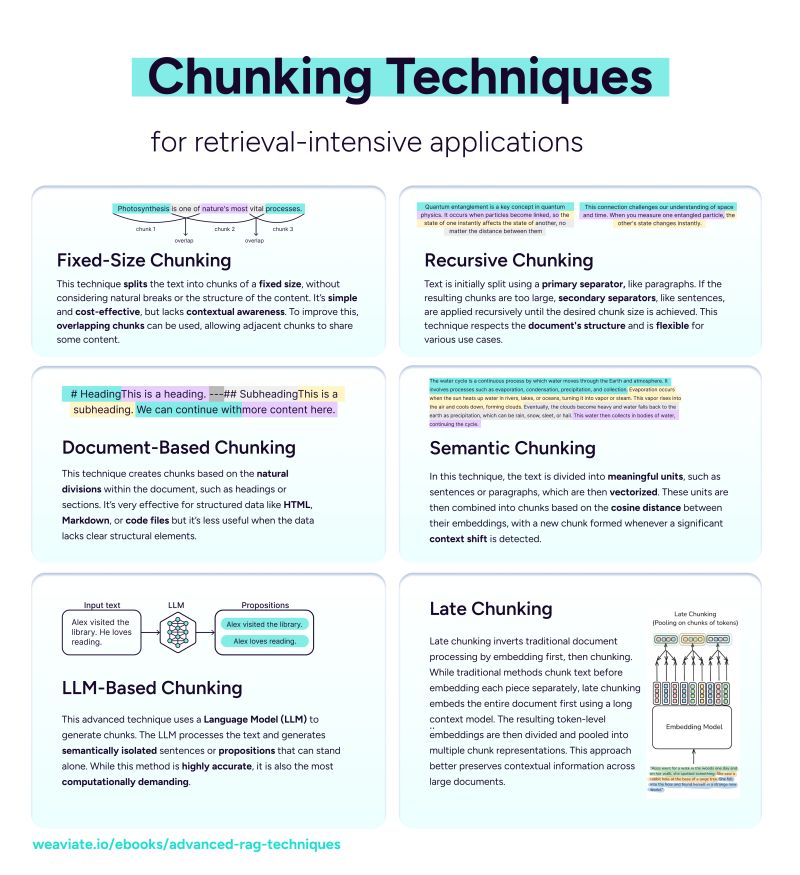
Top 𝗰𝗵𝘂𝗻𝗸𝗶𝗻𝗴 𝘀𝘁𝗿𝗮𝘁𝗲𝗴𝗶𝗲𝘀 you should know:
📏 Fixed-Size Chunking: The simplest approach - split text into chunks of consistent size (e.g., 100 words, 200 characters). Easy to implement but might break sentences awkwardly.
🔄 Recusive Chunking: Hierarchically splits documents, preserving structure while creating manageable chunks. Great for maintaining context across different levels of detail.
📄 Document Based Chunking: Uses natural document markers like paragraphs, sections, or chapters as boundaries. Keeps related information together but can create wildly different chunk sizes.
🧠 Semantic Chunking: Variable-size chunks based on meaning rather than arbitrary markers. More sophisticated but computationally intensive.
⏰ Late Chunking: Embeds first, then chunks - preserving more contextual information in the vectors themselves.
There’s really no one-size-fits-all strategy, like most things, it depends on your data. Your chunking approach directly impacts both information retrieval AND the contextual information provided to your LLM, and is definitely part of this new world of context engineering.
My recommendation: start with fixed-size chunks of ~200-500 tokens with some overlap, then experiment based on your specific use case. Document structure matters - technical documentation might benefit from section-based chunking while narrative text might work better with semantic approaches.
Check out this page for a deep dive into setting up chunking: https://lnkd.in/eahvhSX5
or this ebook for more deep dives into advanced RAG strategies: https://lnkd.in/eg3SDYnV